NZ Geographic – The last of the giants
Kauri dieback
Kauri create shelter and nourishment for other species to grow, but now, a disease without a cure is killing these forest giants one by one. In the past five years, the infection rate of kauri has more than doubled in the only forest where it’s monitored—the Waitakere Ranges. At least one in five trees there are doomed. Can we save the species?
The light falls in long heavy bars through the forest. The sun has just risen, and the rickers cast slender shadows across our path. This is a grove of lamp-posts, of ship’s spars, straight and true. On the breeze is the mineral taste of salt from the ocean below.
Fredrik Hjelm and I are walking through Auckland’s lungs, the Waitakere Ranges, a green cloak laid over the length of the city’s west coast. At the edge of the city, the last suburbs melt into the forest, and then there’s nothing but trees, all the way to the cliffs and the sea.
This is where Hjelm feels most at home. He walks through the forest like a docent leading a tour through an art gallery, stopping every few paces to point out details in the corners: native orchids, which grow only in the leaf litter of kauri, young dracophyllum, spiderwebs finely laced in dew.

“This is sinclairii, with the small leaves; it’s one of my absolute favourites. This as well, this is alseuosmia macrophylla; they have really deliciously smelling flowers. They might be a little bit over flowering now. I think it means perfume in Latin. Yeah, smell that.”
This is all regenerating forest—the ancient trees were logged a long time ago—which means the kauri surrounding us are young, their bark still smooth. You could walk along this track without realising anything is the matter. For a long time, people did.
Maybe one clue is the light—there’s too much of it. Ahead of me, Hjelm has stopped to gaze upwards.
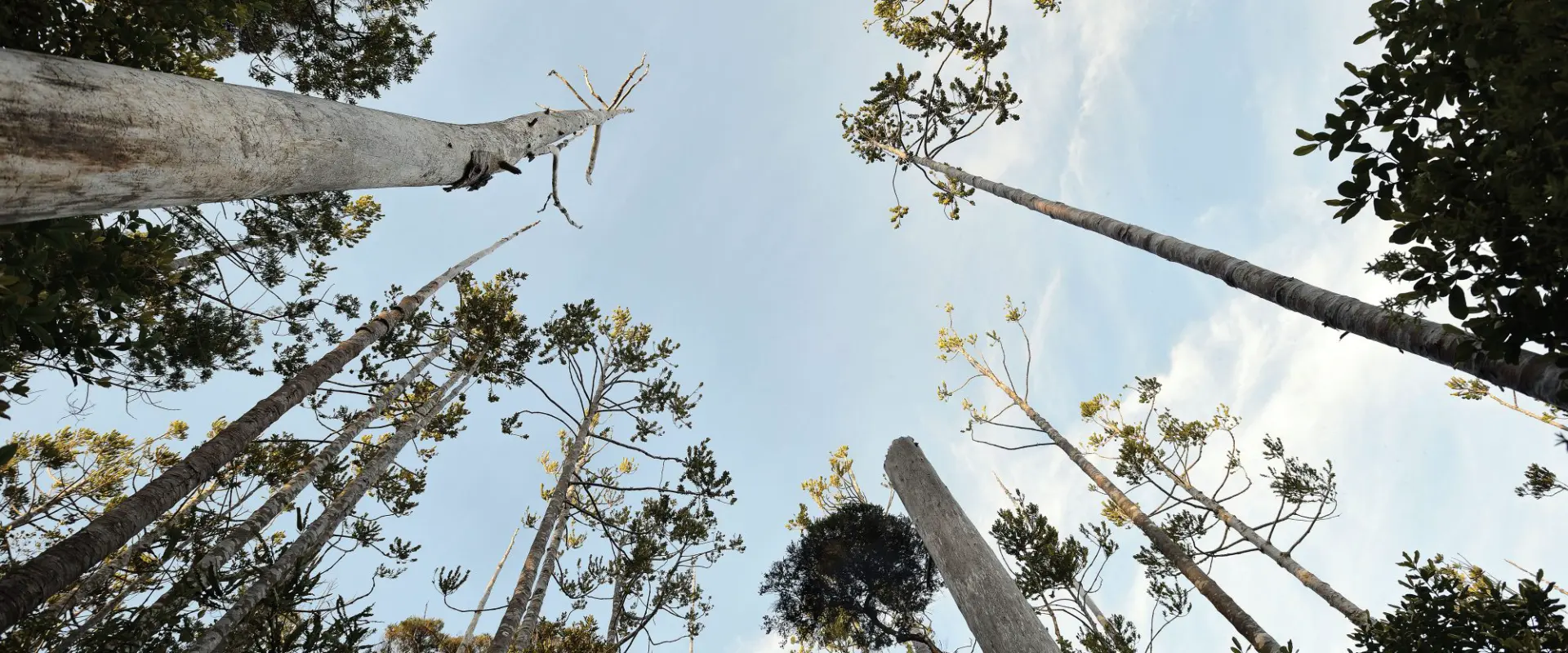
The canopy is tattered like old lace. Most of the rickers end in spear-points. Some have stunted branches, like amputated arms. Some still bear leaves, but these are turning copper and yellow. All of them are dead, or nearly so.
Hjelm has seen plenty of dying kauri before, but this ridge above Piha is a particularly bad spot. He points, off the track, to the forms of trees that have rotted and fallen. High winds bring the dead ones down.
Over the last three years, Hjelm walked most of the Waitakere Ranges’ 256 kilometres of track, part of a team which examined 22,744 kauri for signs of infection. He can spot a thinning canopy where most people wouldn’t notice any sign of ill health. The survey found that 80 per cent of kauri here on Maungaroa Ridge are dead or dying; about a quarter of trees in the regional park are infected.
“You’re such a big tree-lover and then you do this,” he says, and shakes his head. “It’s like walking into a hospital, sick trees here and sick trees there.”
This isn’t a hospital, I think to myself. It’s a cemetery.
Kauri are very sensitive to root damage and soil compaction, so losing an individual tree isn’t out of the ordinary. But as the canopy on Maungaroa Ridge turned from green to rust, a handful of people noticed that it wasn’t just one tree, but most of them.
One of those people was a botanical detective. Ross Beever from Landcare Research had just solved the mystery of sudden cabbage-tree death; now he turned his attention to reports of large stands of kauri mysteriously dying. Thirty years earlier, an area of kauri on Great Barrier Island had succumbed en masse, an aberration at the time, but now the same thing was happening in Waipoua, Northland. And here.
This was in 2006. Beever and his colleague, plant pathologist Ian Horner from Plant & Food Research, soon found a suspect in soil samples: a phytophthora.
Phytophthoras are a family of water moulds, which makes them sound sort of funny and harmless, the kind of thing that grows on carrots at the back of the fridge.

Their name tells a different story—phytophthora is Greek for ‘plant-destroyer’. More than a hundred members of the family are busy wreaking havoc on horticultural industries and natural ecosystems around the world. They are fast, invisible, impossible to eradicate. In their home territories, phytophthoras live in balance with the ecosystem in which they evolved. When they travel abroad, that’s when the problems start.
The most famous member of the family, Phytophthora infestans, hitched a ride from Mexico to Europe in the early 1800s. It had a particular taste for potatoes, and from 1845 onwards, it obliterated Ireland’s potato crop, resulting in the deaths of a million people and the emigration of a quarter of the country’s population. (Put it this way: a water mould, too small to be seen, permanently altered the demography and culture of an entire nation.)
New Zealand’s avocado industry is plagued by Phytophthora cinnamomi—one of the most invasive species in the world—and avocado trees are treated with phosphite every year to boost their immunity. Cinnamomi is present in many New Zealand forests, too, and Beever and Horner suspected it was killing kauri.
But after testing soil from Waipoua, they couldn’t prove a connection between the pathogen and the dead trees. Something didn’t add up. On Maungaroa Ridge, Beever and Horner took more samples, and sure enough, these contained a phytophthora. But this time, Horner looked more closely. The phytophthora wasn’t the right shape to be cinnamomi—or any of the others, for that matter. It was a disease unknown to science, and one whose only known victim was kauri.
*
You can smell a dying tree before you see it: the sweet, sharp scent of resin. Sap bleeds from the trunk, from one place at first, but eventually, the bleeding encircles the tree, preventing water and nutrients travelling to the canopy and upper branches.
The pathogen colonises only the roots.
Once a tree is infected, the only question is how long it will take to die.
In 2014, the new phytophthora received its own name, Phytophthora agathidicida—the second word means ‘kauri-killer’. It’s usually called kauri dieback.
Hjelm and I turn a corner of the track and there’s the source of the fragrance. Bleeding on the ricker ahead is about a metre high—like wax that has melted around the base of a candle, a frozen waterfall of sap. The trees bleed when sap reaches the dead cells, now dead ends, and can’t travel further, bursting out of the trunk instead.
Hjelm reaches up to examine the bleed, and a bracelet of brightly coloured wooden beads peeks out of the cuff of his shirt.

His name and accent are Swedish, but he’s been here for a while now, and he knows the New Zealand forest better than most. He has two young daughters, but apart from them, his life revolves around trees. As well as running his business, The Living Tree Company, he voluntarily leads forest tours for schools and community groups and fellow arborists.
He talks about places which have “really good trees”, and sometimes he adds them to the Notable Trees Register online, where anyone can list a special tree. When he goes on holiday, he looks up trees on the register and visits them. There was an especially good puriri in Opotiki.
“A tree is an asset to a whole community,” he says.
This is an excerpt, click below to view the original article.