Photo essay: the people fighting kauri dieback
Kauri dieback
In a new exhibition, photographer Michelle Hyslop explores kauri dieback through the personal stories of the people close to the trees and their fight to save – and protect – the giants of the forest.
In December 2017 Te Kawerau ā Maki placed a rāhui on the Waitākere Ranges in an attempt to prevent the spread of kauri dieback, a disease that slowly kills the trees. The focus of the rāhui is protection rather than prohibition. The protection of kauri results in the health of the entire forest. Although there was pushback, the scientists working with the iwi were clear that the infection was spreading along tracks from humans. The iwi decided it couldn’t wait for Council to act; the one thing they can control is people, so they moved to keep them out and to give the forest a break while research and track upgrades are being done.
Being an Auckland based photographer, the Waitakere Ranges was my place to connect with nature and explore the trails with my running friends. The closures affected a wide range of people, including myself and it inspired me to research the disease further. I came to realise not only how many kauri had been affected but the impact it was having on people’s lives.
A couple of friends and I used to go night running at Cascades and we would stop at a kauri called Auntie Agatha and spend a couple of minutes looking in awe. I would think, if this tree had eyes, imagine the things it must have seen in its life.
I received a $10,000 Pro Grant from Canon, which provided me with the funding and equipment I needed to get this project up and running as well as printing the photos for the exhibition.
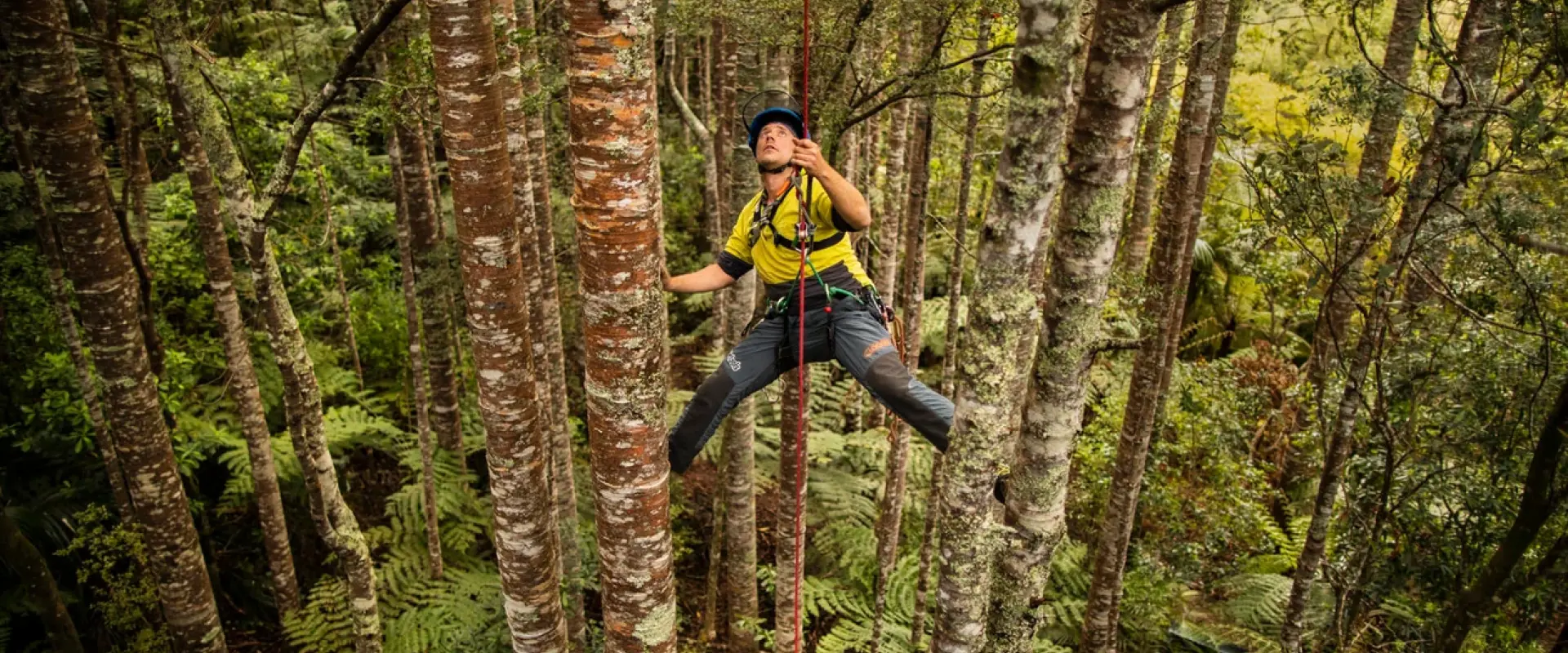
I started by photographing and interviewing people I knew but the project gained a life of its own as word spread and I was introduced to more and more people who were affected by the disease. I was captured by their amazing stories, from Kevin Prime who uses karakia to protect the kauri on his land to arborist Fredrik Hjelm who collects kauri seeds for people to plant and research. Over eight months I photographed people from Motatau and Waipoua Forest in the Far North to Rotorua, meeting local iwi, scientists, and members of the public who had a kauri story to tell.

Kaumatua Kevin Prime, of Ngati Hine, Ngapuhi, Ngati Whatua and Tainui Iwi, standing beneath kauri, Motatau (Caption: Andrea Ewing).
None of the kauri trees on Kevin Prime’s 1060 hectares in Motatau have suffered dieback. And although he hosts a mountain-bike race every year, he doesn’t ask riders to clean their bikes before entering his land. Why are his kauri still healthy?
Kevin explains he uses karakia to protect the trees on his land. He calls upon the creator to send spirits of healing to his native trees, and to drive out epidemics, like kauri dieback, from his land.
Karakia is often translated simplistically as ‘prayer’, but Kevin explains that its meaning is richer. The word combines ‘ka’ (about to happen; glow), ‘ara’ (to awaken; pathway), ‘ki’ (to); and ‘ā ia’ (the supreme being). More accurately, karakia means ‘the awakening of communication with the creator’.
Kevin offers his karakia for others to use; when it’s spoken, the speaker’s intention must be to connect with the creator of the trees. Standing among his own trees, he smiles gently. “The use of karakia does not cost anything. All it takes is the belief of the person to think it and make it happen.”

Kelly Kahukiwa, of Whakaue, Pataheuheu and Te Aitanga a Makaki iwi, holding a pūrerehua in the shade of kauri trees. A H Reed Memorial Park, Whangarei. (Caption: Andrea Ewing).
Kelly Kahukiwa and Daniel Nathan, of Te Roroa iwi, lead a project called Te Reo Ngaro o te Rākau (the hidden voices of trees), which melds Mātauranga Māori (Māori scientific observation) with arts, music, education and acoustic technology. Both believe there’s a hidden language that exists inside the trees, and are recording these ultrasonic frequencies from te wāhi ngaro (the undiscovered world), to bring them out of the ultrasonic spectrum and into human hearing range.
Rangatahi (young people) will help record these sounds and rhythms to make music from them. Kelly hopes rangatahi will be encouraged to re-connect with the forest: “we’re searching, we’re discovering, and we want to do this with our young people beside us, doing this with us.”
Although they’re recording all native trees, they’re curious to listen to kauri that are healthy and also kauri with dieback, to see whether the trees’ internal rhythms signal whether they’re sick.

Tammy Downes and her daughter Eloise, enjoying the shade of a majestic kauri tree on their property in Laingholm. (Caption: Andrea Ewing).
Tammy Downes was devastated when she discovered the one hundred kauri trees on her family’s land were all infected with dieback. She has treated the trees herself with the help of Kauri Rescue volunteers. They drill holes around the trunk, inject phosphite, and leave the syringes to expel. The kauri will need ongoing treatment to prolong their lives.
Tammy wants people to get on board and start helping. “If we lose them, if we let that happen, what are we going to say to our children and our children’s children? I want my daughter to be able to bring her children back to her house here, and I want them to be big, strong, beautiful kauri trees.”

Trail-runner Christian Stockle on the Te Henga trail, near Bethells Beach (Caption: Andrea Ewing).
When Christian Stockle moved to New Zealand from the UK six years ago, discovering the Waitākere Ranges was fundamental to him putting down roots here: “you’ve got this incredibly diverse range of pristine trails in forest” on the doorstep of the biggest metropolitan centre in the country.
He sees the forest as an asset for the city’s health: mental health and obesity have become epidemics in New Zealand and moving in green spaces “helps keep you sane” and fit. With the park closed, children are no longer able to learn to move and play in the outdoors. He’s sad about kauri dieback, but also feels the closures are a “knee-jerk reaction” and won’t change the diseases’ presence in the forest.
This is an excerpt, see below to read the full original article.