Räddar heliga träd på Nya Zeeland – Sveriges Natur
Kauri dieback
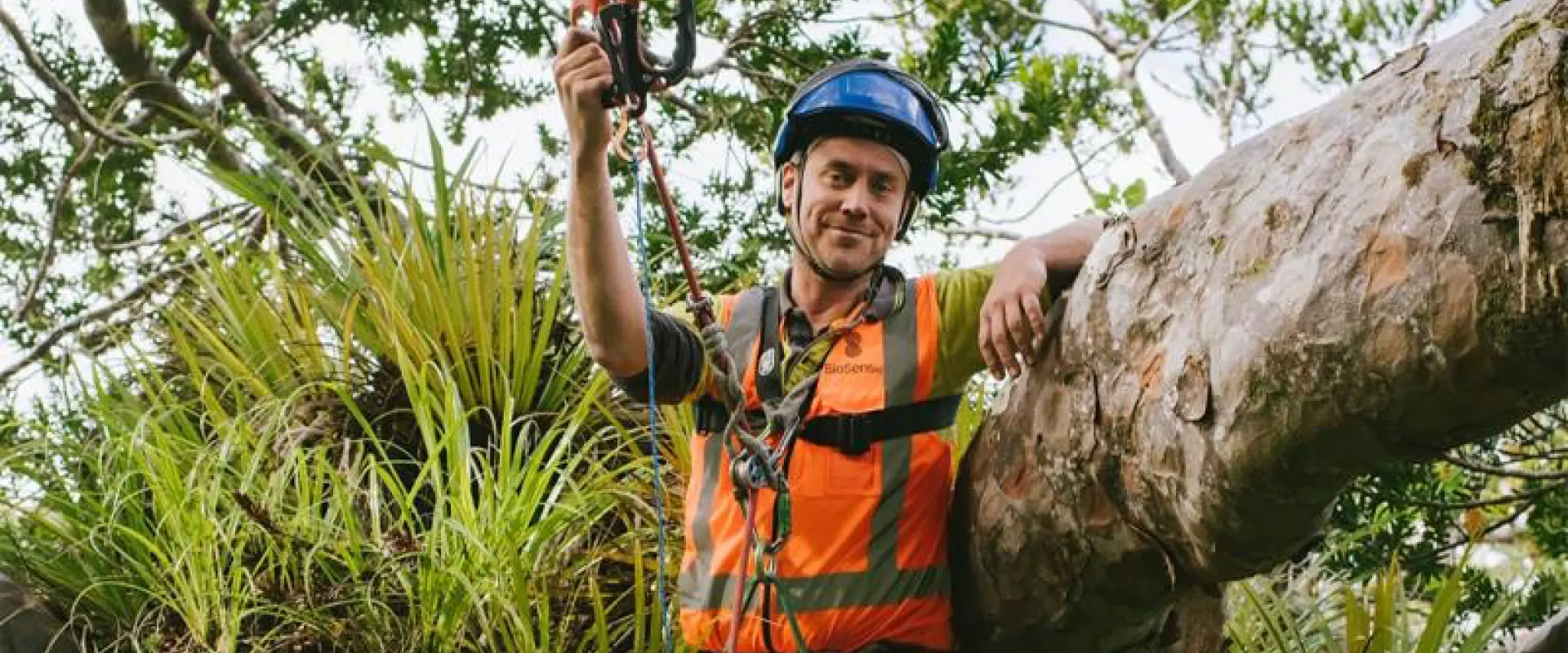
Fredrik Hjelm works in sacred tree canopies. The goal is to save the kauri trees and create awareness. His smile says it's worth it.

A woman dips a couple of bright green leaves in a mug of water, lifts them and lets them drip over the ropes, harnesses and other climbing equipment that fill the boot of a pickup truck. She closes her eyes and chants in Maori. Fredrik Hjelm and his team of arborists, researchers and artists stand silent. For most of them, it is a big day. They are going to climb New Zealand's largest tree. Tane Mahuta, as it is called – named after the creator of the earth according to Maori mythology – is a kauri tree that is around 2,000 years old, and was a giant long before humans first set foot in the country. The Maori people consider the tree sacred and usually do not let anyone even touch it. But now it is threatened by a deadly disease, which requires extraordinary measures. Taoho Patuawa is responsible for the project from the local community.

“I couldn't sleep a wink last night,” he says.
Fredrik Hjelm flashes one of his broad, reassuring smiles.
– I slept like a baby.
It's often like that with Hjelm. He stands firm. A plus for any arborist, but a must in his particular role. As a key figure in the fight to save one of New Zealand's most iconic species, things often get stormy around him. The future and history of the kauri evoke strong emotions. In a couple of hundred years, the tree has gone from completely dominating the country's northernmost landscape to being threatened with extinction.
European colonizers have devastated most of it. Now what remains is being attacked by an extremely contagious pathogen – Phytophthora, literally “the plant killer”. Opinions on how to tackle the problem vary widely, and many have burned out. However, everyone agrees that more research is needed up in the trees, and there is only one person to turn to. No one has spent as much time up in the kauri, probably ever, as a 40-year-old from Partille.
Hjelm opens the door to a metal cart outside his cottage in Auckland. Steam billows out and he is pulled into an embrace with bright pink, neatly lashed rope.
“I used to get shaky just standing on a chair and changing a light bulb,” he says. I guess overcoming fears has been part of my journey.
There is a splash as another load is loaded into the cart. Soon several hundred meters of rope and other equipment are in the 60-degree water bath. After an hour, they will be disinfected – a method he developed in consultation with researchers to prevent the spread of the infection.
– The goal is to be able to play a small, small role in ensuring that my daughters and their daughters also get to experience kauri. They are unique trees. It's hard not to feel small in their presence. And it's good for us humans to do sometimes.
Fredrik Hjelm ended up in New Zealand during his first career as a chef and later returned to train as an arborist. It is a rich field for the profession. The country is home to over 200 endemic shrub and tree species. In the crowns of kauri trees, he came into contact with completely new ecosystems.
“You're standing on a branch as thick as a car, surrounded by vines, trees, orchids, lizards,” he says. “It's a very special feeling. To be in a world where no one has been before. Ever.”
New Zealand's ecology, however, faces major threats. Cities are growing, the land is being intensively farmed and more and more alien species are encroaching. Efforts are therefore being made to protect and promote indigenous natural values. The Maori population is a central piece of the puzzle in this work. Kauri stands above all on its land.
Two years ago, Fredrik Hjelm was the lead researcher on a project involving fourteen different ethnic groups. His team collected seeds to map the genetics of cowpea and its resistance to phytophthora. Some were difficult to persuade.
“Often those meetings would start with a challenge,” he says. “Why was I worthy of coming there?” Sometimes something as small as who would print a map could lead to a shouting match.
Hjelm returned to the same places, sometimes with his children.
– It's all about personal contact. And ultimately, they are the ones who must guide us on how to conduct ourselves in the forest.
The collaboration has led to strong moments.
“One of the most daring things is to bring up Maori in trees that they have lived and worked with for generations, but whose crown they have never visited,” he says. Seeing their happiness is an incredibly beautiful experience.
Fredrik Hjelm attaches a rope secured 20 meters up one of Tane Mahuta's branches to his carabiner and begins to climb. The movement resembles treading water, a rhythmic stepping of the feet, with the effect of a fast, steady climb when performed by an expert. The goal is to pick leaves from all parts of the tree, a task that is both difficult and risky as it takes the arborists tens of meters away from the trunk. Hjelm, however, focuses on the second job of the day, which is to guide a researcher and an artist up to the crown along with their equipment. The researcher, an evolutionary ecologist, will make measurements of the crown's color spectrum, which will enable drone studies of the forest and its health. The artist, Joseph Michael, will scan the tree so that it can later be exhibited in three-dimensional form in urban environments.
They have received funding for a similar project in the Amazon.
“The idea is to create awareness of how magnificent the forest is,” says Hjelm. Fewer and fewer people grow up with nature around them and have a weaker relationship with it. This is then noticeable in parliamentary elections and in other priorities we make.
He smiles a defiant smile.
– All of us who work with climate and nature are dealing with a bleak situation. Then I try to remind myself how lucky I am. To stop in the crown of a tree, and take a sip of life.